
We Brought a Language Education Giant's 72 Branches Onto a Single Platform

We came together with American Life as a co-founder. Our goal was to bring the entire scattered operation of a language-education institution spread across 72 branches — from sales to classroom planning, from collections to a student's online lesson — onto a single cloud platform. We shipped the first version in 2024. Today Joedtech is a SaaS product used every day by more than 5,000 people, from managers to teachers, from the sales team to students. From the idea stage onward, we at Phexum have run its architecture, its web and mobile apps, its design and its uninterrupted operation end to end. Not as a vendor, but as a companion, we keep growing it together.
Featured Results
Today Joedtech runs the daily work of American Life's entire branch network from a single screen. Thousands of users connect concurrently and work with low latency. On top of three core modules — CRM, LMS and JAM (Joedtech Activity Management) — new ones are added continuously, and the product has kept expanding since its first release in 2024. The engineering, design and operation behind this whole stack are consolidated in one place, at Phexum.


Who the Client Is and the World They Live In

Founded in 2007, American Life is one of Türkiye's well-established foreign-language education institutions. It offers training primarily in English, as well as German, Russian, French and Spanish. It operates a network spanning 72 branches across dozens of Turkish cities and reaching Baku abroad. For us, American Life plays two roles at once: Joedtech's co-founder and, at the same time, its largest enterprise user. They brought the field's education experience; Phexum brought the technology muscle.
At this scale, the daily reality of an education chain is in fact an operational nightmare — and this nightmare is lived not only by managers but by everyone in the field. When every branch keeps its own leads, its own class schedule and its own collections in different, disconnected tools, that fragmentation eventually turns into a serious management burden; even a simple conflict like a teacher being assigned to two classes at the same time is noticed only after it is too late. The problem does not end there: when a teacher does not know where to record attendance, a student where to submit homework, or how to join an online lesson, the disorder directly affects the quality of education. Joedtech was born precisely to remove this blindness on the headquarters, field and student sides alike.
Cross-Cutting Concepts and Architecture

Joedtech's greatest strength is not its individual modules but the architectural choices that run through all of them. Chief among these is matrix-based role and organization management. This works not as the feature of a single screen but as a nervous system that runs through the entire product. A user can have access to many brands or branches, and the same user can be positioned as a teacher in one branch while being an appointment manager or class planner in another. Which branch a user sees, under which identity they manage what and where, whether they can approve a collection, or whether they can edit a class schedule — all of this is fed entirely by this dynamic structure. This structure solves the biggest complexity in SaaS architectures, because the real question it answers is not "who are you" but "in which branch, with which hat, what can you do." In a multi-branch, multi-layered brand like American Life, its practical meaning is this: a single user can switch between their changing roles across different branches with one click and carry out operations, and can never touch data they are not authorized for.

Alongside this, the multi-layered data model is equally decisive. Brand, branch, user and student live in the same tree; headquarters sees every branch consolidated at a glance, while each branch sees only its own world. To keep this sustainable, we split the product into independent domains bounded by business rules. The name of this approach is domain-oriented design, that is, DDD (Domain-Driven Design). It means building the system not by technical layers but by its real-world business counterparts (sales, education, appointments) and by the boundaries of those domains. This way, the complexity of the same user taking on different roles in different domains can be managed cleanly in the code architecture without getting entangled. To this we added the CQRS (Command Query Responsibility Segregation) approach, which separates write and read operations. When thousands of users look at reports at the same time while new records are being entered, the system can run both without them tripping over each other. By keeping frequently accessed data in memory with Redis we made screens open instantly, and we set up search and filtering with Elasticsearch to respond in under a second across millions of records.
How the Collaboration Began
Joedtech is one of the most concrete outcomes of Phexum's "We Build Startups" approach. American Life had a problem that compounded with its growing branch network: customer relations, the education calendar, collections and appointment processes were each managed in separate tools that did not talk to one another. We looked at this not as a service line item, but as a product opportunity.
Instead of the distance between vendor and client, we built a partnership; we shared the risk and the vision and designed the first version together. American Life knew what the field wanted, and Phexum turned that into a platform capable of carrying thousands of users. The first step was not flashy: we rolled the MVP — launched with a core module — out to real branches, and shaped the product with the feedback that came back.
How the Story Was Built
The journey began with an MVP in 2024. We first shipped a narrowly scoped initial version, tested it with real users at American Life branches, and iterated quickly on the incoming feedback. We improved a little more each cycle until a tool the field teams actually used emerged. A single-module start settled over time onto three main pillars — CRM, LMS and JAM — and from there expanded with continuously added new modules and features.
Because we foresaw this growth from the very beginning, we designed the architecture accordingly. We built Joedtech not as a single giant block but as a structure made of parts that can grow independently. This way, adding a new module did not put the rest of the product at risk, and as the number of users grew the system could be strengthened point by point.
Building Blocks of the Solution
Joedtech works by connecting three core modules together, and they share the architecture described above.
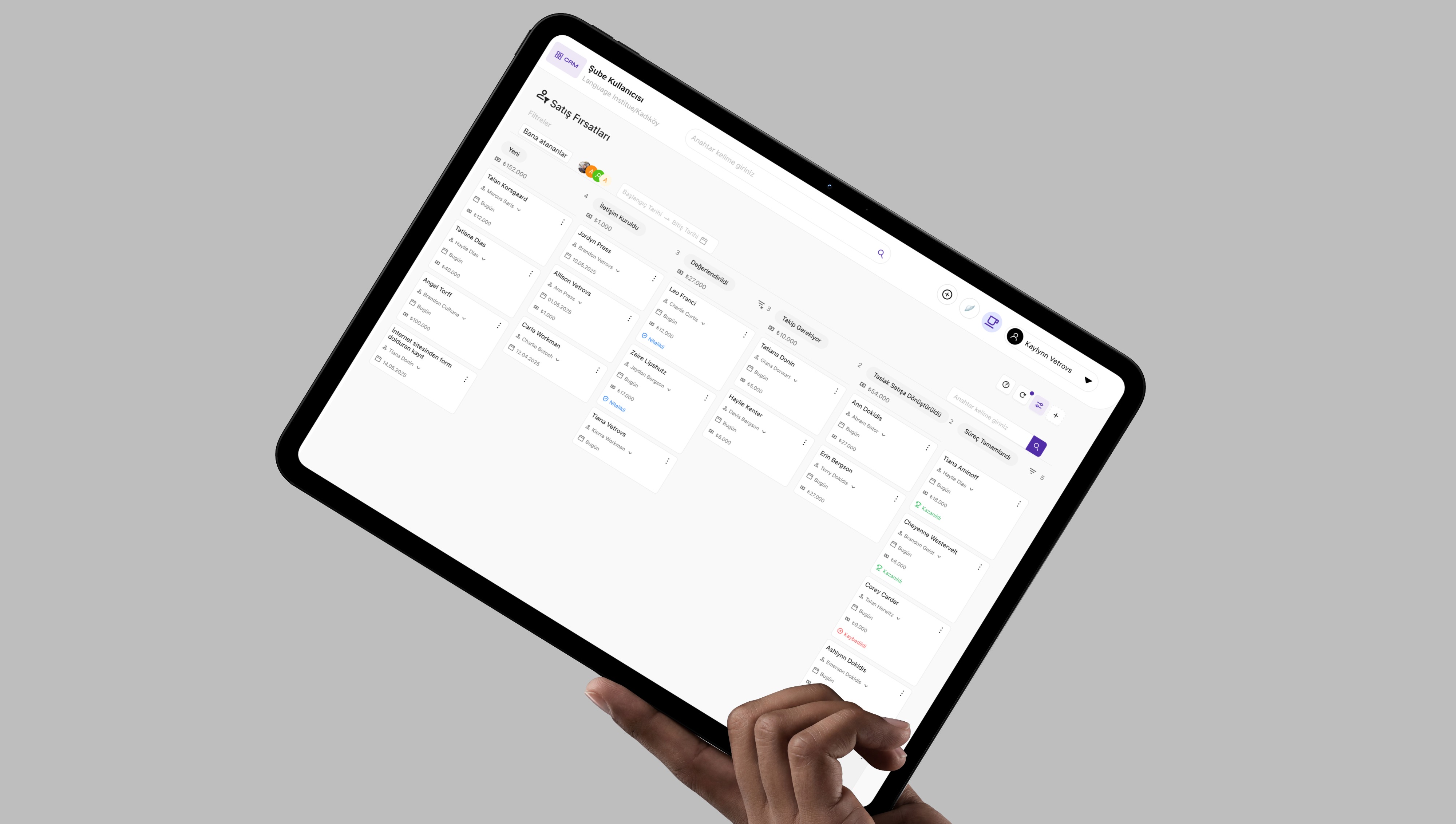
CRM and sales management is the layer where the institution converts a prospect into an acquisition and builds its corporate memory. Leads coming from ad channels or branches flow into the system, get classified and assigned to sales teams; meetings and calls are managed from the calendar while team performance is reported in real time. Collections are tracked per branch or consolidated, and customer communication is run from a single center through integrated SMS and notifications.
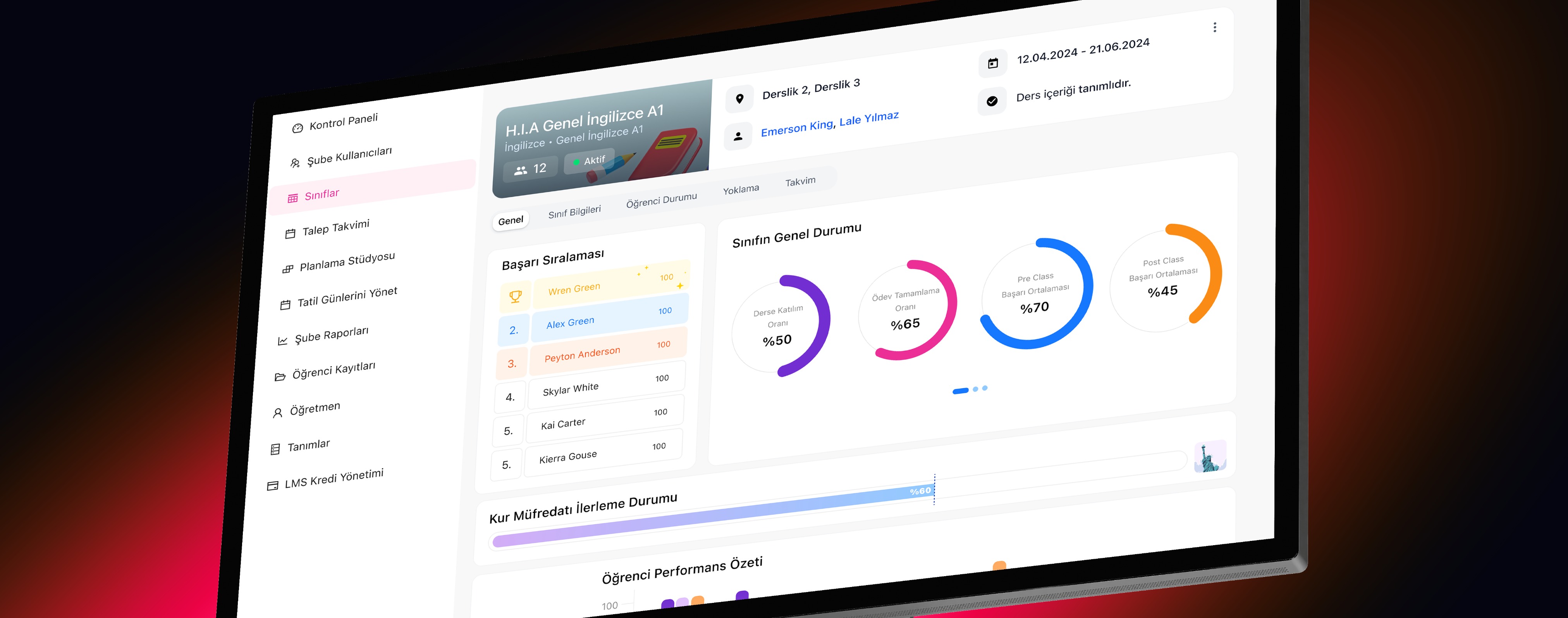
LMS, the learning management system, is the module that moves academic operations to digital and brings the manager, the teacher and the student together on the same platform. Joedtech's own curriculum structure forms the basis of this module; institutions can modify this curriculum to fit their needs, create their own course content, and students can access this content through the platform.
Once a class is created, the story continues in the hands of the teacher and the student. The teacher manages their own lessons, attendance and class flow from a single screen and assigns exercises and homework to students. The student solves their homework on the platform, submits it for the teacher's assessment, and tracks their progress with the score they receive. They also earn points by solving exercises in different formats before and after the lesson — speaking, multiple choice, fill-in-the-blank and matching — and can access the digital content the teacher covered in class not only during the lesson but afterward, to study again. The AI-powered spoken and written conversation-practice feature gives the student the chance to practice after the lesson. This way the platform goes beyond being a management tool and turns into a place the student lives inside as part of their daily learning experience.
Class Planning Studio
One of the most prominent parts of the LMS is the drag-and-drop class planning studio. The planner assigns classrooms, dates and teachers through an interactive interface, while the algorithm in the background simultaneously checks the availability and capacity of teachers, students and classrooms, preventing conflicts and planning errors from the start. For example, an error like a teacher being assigned to two classes at the same time — once noticed only after it was too late — is now caught by the system at the planning stage. This means a task that used to take hours and left no room for mistakes now drops to minutes.
JAM, that is Joedtech Activity Management, is the appointment and event architecture that boosts internal efficiency. Internal operations, events, club activities and appointments are organized with a flexible calendar structure; with recurring-event definitions, entering the same task by hand again and again is eliminated and the operational load drops to a minimum. Students, too, can book the events the institution organizes through JAM.
A teacher can now schedule a class in seconds instead of hours.
How We Scaled
Thousands of people connect to the system concurrently through web and mobile apps, and all of them expect instant responses. To handle this load, we designed the product to be horizontally scalable from the start: we built a structure that distributes incoming traffic across multiple servers, so we could keep adding capacity as the number of users grew. On the back end, services built on NestJS, PostgreSQL as the single source of data, Redis for speed and Elasticsearch for search work together. On the front end, the interface we built with React, along with the Android and iOS apps on mobile, carries the same product vision to the field. Thanks to this structure built with CQRS and DDD, adding a new module to the system became possible without the risk of breaking the rest, and the product has expanded without pause from 2024 to today.
The Impact We Created
The project, which started with a single module, has today turned into a mature platform running daily work in American Life's 72 branches and in the hands of more than 5,000 users. Sales, education, collections and appointment processes — once split across scattered tools — are now under one roof. Headquarters sees every branch at a glance; each branch works freely within its own authority. The teacher manages their lesson and attendance from one place, while the student follows their schedule, online lesson and homework from the same app. We combined American Life's field experience with Phexum's engineering in one product, and this partnership keeps growing with every new module.